Book Announcement: Object-Oriented Philosophy

I promised an exciting announcement, and here it is. As anyone who has read this blog for a while knows, I have a long history with Object-Oriented Philosophy/Ontology, having criticised it quite extensively on this blog before (see here). I even published an article on it two years ago, titled ‘The Noumenon’s New Clothes’ (see here), which was quite optimistically subtitled ‘Part I’. I’m sure some people have been wondering what happened to Part II. The answer is that it got a bit out of hand, and the two part article grew into a full length book, which is about to be published by Urbanomic as part of their excellent new set of titles.

Of course, this might strike some people as overkill, but I’m quite proud of the book. It is a pretty scathing critique of Harman’s work, but it is more than just this. At the very least, it makes sense of certain metaphysical issues that OOP/O overlooks in its rush to speculate; locates OOP/O in a wider philosophical trend that I name ontological liberalism; and presents an account of the history of philosophy from Kant onwards that explains the evolution of correlationism, while incorporating both analytic and continental traditions. It also has a postscript written by Ray Brassier (‘Speculative Autopsy’), in which he gives us the last word on ‘Speculative Realism’. I thoroughly recommend you all pre-order it now!

P.S. I’ve also written the entries on ‘The Necessity of Contingency’ and ‘Ray Brassier’ in the forthcoming Meillassoux Dictionary

Online Course: Reintroduction to Metaphysics

Good news everyone! The New Centre for Research and Practice has asked me to teach an online course as part of their grand experiment in online pedagogy. In contrast to my more recent online offerings in which I’ve been dealing with issues in philosophy of mind, artificial intelligence, freedom, and beauty, I’m returning to some earlier theme explored on this blog under the heading ‘Reintroduction to Metaphysics’. This is a two part course, each half of which will consist in four weekly two and a half hour seminars, which will be roughly evenly split between lecturing and group discussion over google hangouts. This will be supplemented by structured online discussion over google classroom. There are a limited number of spaces available for those who want to take full part in the course, which includes involvement in the group discussions and essay assessment, but anyone who likes can pay to audit the course in real time or after the fact. For more information on dates, times, prices, and whatnot please consult the new centre page or the facebook page for the course. For more information on the content of the course, see the brief outline below.

I will also have another exciting announcement later this week, with any luck.

Reintroduction to Metaphysics

The end of metaphysics was a dominant theme in early 20th century philosophy. Even though the Western philosophical tradition sundered in two, one of the few things its analytic and continental halves seemed to agree upon was that the age of metaphysics was over, either because physics had finally usurped it or because philosophy had finally rooted out the pathological desires which drove us to speak of the fundamental structure of reality. The resurgence of metaphysics in the second half of the century in both traditions certainly came as a surprise, even if it has taken till the turn of the 21st century to become ingrained in both camps. However, despite it’s increasing popularity, there remains much confusion about precisely what metaphysics is: How does it sit within philosophy as a whole? How does it relate to the sciences (especially physics)? How do we go about doing it?

The purpose of this module is to reintroduce metaphysics by considering these sorts of methodological questions, and to do so by explaining the history of its rise, fall, and rise again. It will be broken into two halves:

Part I: The Speculative Return

We will begin by examining the return of speculative metaphysics, focusing primarily upon the advent of ‘Speculative Realism’ and its ramifications. This will provide us with a way of framing the historical arc of the decline of metaphysics (correlationism) and some purchase upon what has potentially been overlooked in the drive to speculate (the critique of metaphysics). We will address certain issues in contemporary metaphysics, but tour principal aim will be to construct a historical narrative through which to articulate the methodological questions these raise.

Part II: Metaphysics and Method

We will open by consolidating the methodological issues discussed in the first part, and attempt to present an account of what metaphysics is. This will provide answers to the most pressing questions regarding the philosophical role of metaphysics (e.g., its relation to science) and a methodology for orienting ourselves towards specific metaphysical questions (e.g., the problem of universals). We will then address a number of these specific questions, examining classical and contemporary debates on a number of topics from within this new methodological framework.

Some Translations

This is a short post to point people at some translations of my work done by some really fantastic people. I am in awe of people who take the time and effort to translate philosophy into other languages, as I have some understanding of how necessary and how thankless a task it is, but I am doubly in awe of anyone who translates my work to make it accessible to another audience. I am embarrassingly monolingual, and am grateful for any opportunity to engage with non-English speaking audiences.

Anyway, here are the relevant pieces:

1) My ‘Ariadne’s Thread’ paper on Deleuze’s metaphysics, translated into Spanish by Leonardo Bahamondes (here)

2) My ‘So, Accelerationism, what’s all that about?’ post from tumblr responding to Malcom Harris’ review of the #Accelerate reader, also translated into Spanish, this time by Giancarlo Sandoval (here)

3) The first part of the 5th Chapter of my PhD thesis on Heidegger, translated into Serbian by Milan Markovic (here)

Get Reassembled: PAF Seminars

I’ve just gotten back to the UK from France after visiting PAF, as part of Get Reassembled: Time, Intelligence, Acceleration. This was a really fantastic event, and I can’t thank the organisers enough (Amy Ireland, Katrina Burch, and Deanna Khamis; with special mentions to Lendl Barcelos and Ben Woodard) for putting it together and inviting me to contribute. My contribution took the form of three seminars, which were very graciously streamed and recorded by The New Centre for Research and Practice. The seminars covered a lot of work I’ve been doing in various areas for several years, a good deal of which is catalogued here on deontologistics, but which I haven’t before had the chance to present in a unified form. As such, it is only fitting that I present them here, along with links to the reading I recommended for those attending them. The first two seminars are around 2 hours each, though the last is over 3 hours, partly because of the need to pull together the disparate ideas into a coherent thesis, but also because of some very good questions and subsequent discussions initiated by the participants. This is a lot to watch, but some of you might find the whole thing to be worth the effort.

Freedom, Reason, and AGI 

Required: http://www.theguardian.com/science/2012/oct/03/philosophy-artificial-intelligence 

Required: https://deontologistics.wordpress.com/2013/03/06/freedom-renewed/

Optional: https://deontologistics.co/wp-content/uploads/2014/07/metzinger-paper-uwe.pdf 

Desire, Autonomy, and Capital

Required: The first two sections of this post: https://deontologistics.wordpress.com/2011/04/22/comments-on-capitalist-realism-part-1/ 

Required: http://deontologistics.tumblr.com/post/91953882443/so-accelerationism-whats-all-that-about

Optional: The rest of the CR post and http://incrediblemachines.info/respondents/wolfendale/ 

Beauty, Justice, and Acceleration

Required: https://deontologistics.co/wp-content/uploads/2013/04/art-kettle-review.pdf

Optional: https://deontologistics.wordpress.com/2012/01/02/for-the-love-of-spinoza/ 

Optional: https://deontologistics.co/wp-content/uploads/2013/05/wolfendalefreedom.m4a

Diagrams

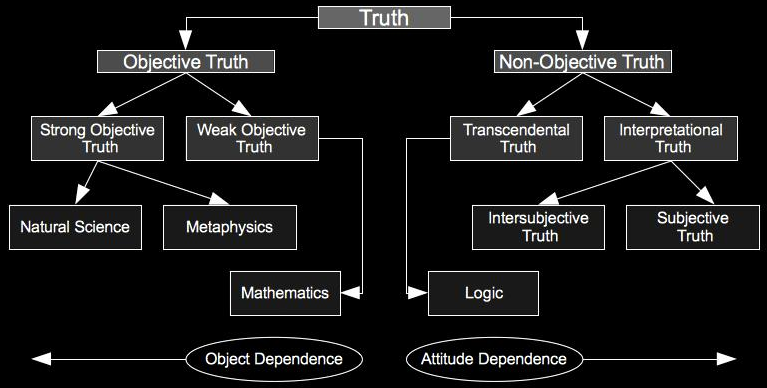
I normally don’t post images on the blog, but I’ve just realised that I now have some diagrams of my own to put up. Here’s the two diagrams from my essay, suitably inverted to match the decor, just to wet the appetite of anyone who hasn’t taken a look at it yet.

First, the outline of my taxonomy of truth.

Second, my partitioning of the set of truth claims (i.e., those things we take to be true).

Transcendental Realism Ahoy!

Hello all, the Transcendental Realism workshop is on tomorrow. I’m busily finishing my paper, and the some of the speakers will be congregating later today (in my house). This post is primarily a series of brief announcements for those who both read my blog and might be turning up, followed by a little excursion on something related to my paper.

1. Announcements

First, the running order of the speakers hasn’t been decided yet (apart from Ray, who will be on last). We should have it up tonight though, once we’ve had a chance to talk it through between us. However, whichever way it turns out, it’s going to be a tight schedule. Registration begins at 12:00 in LIB2, so there’s a bit of time to mill about and chat beforehand, and the first talk starts at 12:30. We’ve then got 5 talks, each of which is 30 minutes + 15 minutes of questions, to squeeze in between then and 5:00pm. This means that we’ve only got time for one measily break of 15 minutes during that time. At 5:00pm there’ll be a 30 minute break, where we’ll shift rooms to to S0.11, which is quite close. Ray’s talk will then begin at 5:30, and you can expect it to go on till 7-7:30.

All of this means that there will be precious little time for grabbing food, so I recommend getting yourself some food before you get here (or during the registration period, from the library cafe around the corner). We should be heading for food an drinks afterward Ray’s talk, depending on where will accommodate us.

Second, I’m still writing my paper, and it’s currently a bit long. This means it might have to be a bit dense to fit into my timeslot. I’ll do my best to make it as comprehensible as possible, but, if you wanted to do a bit of preparatory reading, I’d recommend Meillasoux’s presentation at the original SR conference, published in Collapse III. As well as tackling Meillassoux, I’ll be taking you on a whistle stop tour through analytic metaphysics (Quine, McDowell, Blackburn, Lewis, Price and Brandom), and even taking some time to talk about Hegel’s concept of natural consciousness from the introduction to the Phenomenology of Spirit. It should be very interesting, if I can squeeze it all in.

2. What does ‘real’ mean? Vs. What is the real?

Given that it is relevant to my paper, I thought I’d comment briefly on something Graham Harman and Peter Gratton talked about yesterday (herehere and here). It all starts with this point by Graham:-

I suppose you could take the eliminativist route and claim that the sensual objects don’t necessarily exist in any sense (this seems to be the heir of Russell’s response to Meinong). But the problem with eliminativism, as I see it, is that it makes no room for real objects at all. Its sense of realism is that of scientific realism, and so there isn’t any concept of withdrawal there. The difference between real and unreal, for that position, is is simply a difference between realimages and scientific images. It is a mere metaphysics of images, despite all its huffing and puffing about reality.

You can see this in Ladyman and Ross, and you’ll also see it this summer in Brassier’s piece in The Speculative Turn, which takes a few digs at the “metaphysical” distinction between real and sensual, demands “criteria” for distinguishing between real and unreal, and neglects to admit that it has already made a metaphysical decision by assuming that all that’s at stake is the development of criteria for calling some images Bad Folk Images and others Good Scientific Images.

But philosophy is not just about images, and the sense of the real in scientistic philosophy is generally quite feeble. These positions collapse into pragmatism or instrumentalism at the slightest touch. “Realism” for them really just means: using science to beat up unscientific people. The real is never addressed at all.

Now it may come as a surprise that I have a certain amount of agreement with Graham here. The main point of the paper I’m going to give tomorrow is that most forms of realism don’t know what they mean by ‘real’. The only form that I think has a good idea of what it means is what I call deflationary realism.

Deflationists point out that classical realism wants to deploy a thick sense of ‘real’, but that it doesn’t know what it means by it, and so in response they propose a thin sense of real. This thin sense of real is usually indexed to truth. So for example, whereas the platonist (a local realist) says numbers really exist, and the nominalist (a local anti-realist) says numbers don’t really exist, Quine (the deflationist) comes along and says that the ‘really’ doesn’t make any sense here. Quine says that if we take there to be true statements in which we quantify over numbers, then we’re committed to their existence. If it is true that ‘there are infinitely many primes’ then numbers, and more specifically prime numbers, exist. This makes the question of whether numbers exist a completely trivial matter. So, yes, deflationists have a fairly feeble notion of ‘real’, but they’re pretty explicit about it. However, there are many others who have quasi-deflationist positions which are very problematic (I’d even go so far as to say inconsistent).

However, I’m not sure that Graham has the high ground here. Yes, like many other classical realists he has an account of what the real is. I just don’t think he’s got any better an idea of what ‘real’ means. This is the difference between having an account of what the real is, and having an account of what it is to have an account of what the real is. This is analogous to the difference between knowing who the president of the united states is, and knowing what it is for someone to be president of the united states. It’s perfectly possible to know that Obama is president, and nonetheless have a hazy idea of what this means. I think there’s a fairly simple way to demonstrate this point.

If we take ‘real’ to mean ‘that which is radically independent of thought’ in such a way that this is equivalent to ‘that which withdraws’ in Graham’s sense, rather than simply to be ‘that which withdraws’, then the concept is not sufficiently broad to perform two different functions that it’s required for. First, it is required to distinguish between real objects that withdraw and the sensuous objects that don’t. It does this adequately. However, it is also required to describe precisely what such a distinction is doing. We need to be able to say that this distinction is getting at the real metaphysical structure of objects. As I’ve mentioned in previous posts (here and here), Graham thinks that the real properties of each object are unknowable (except through allusion), insofar as they withdraw, but he nonetheless thinks that this very fact (which is not a fact about any given object, but about objects qua objects) is knowable. This means that the second use of real cannot be equivalent to ‘that which withdraws’, because it would automatically disqualify the possibility of such metaphysical knowledge (in effect, we’d be back in correlationist territory).

Now, this second use of ‘real’ is necessary in order to delineate the task of metaphysics. Specifically, it is necessary in order to counter deflationism and positivism. When the deflationist says “there is nothing more to the structure of objects than our talk about the objects”, and when the positivist says “there is nothing more to objects than decreed by science”, Graham must be able to turn around and say that no, there is a real structure of the object in excess of either, and it involves withdrawal. As such, I don’t think that Graham is in a much better position than scientific realists, and I certainly don’t think he’s entitled to claim that he’s more of a realist than they are.

Anyway, there will be more on this problem tomorrow. Back to writing my paper!

Rational Animals

I’ve written a piece for the Speculative Heresy/Inhumanities crossover event on Realism and Ethics, and it’s been selected to be the first put out on Speculative Heresy (here). I managed to go over the word limit by 500 or so (the piece is 2,500 words or thereabouts), and as anyone who reads this blog already knows, I find it difficult to constrain myself to anything less than 3,000. I’m happy with it overall, although I do introduce some more technical stuff with regard to rationality and normativity that I can’t fully back up there for space reasons. Regardless, I’m very happy to have contributed, and I look forward to the rest of the essays!