The Art Kettle

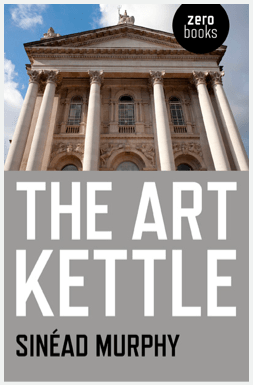
This post is in many ways long overdue. I received a free copy of Sinead Murphy’s The Art Kettle last year, with the promise that I’d review it. The book made an instant impression on me, but for various reasons (personal and professional) the review went by the wayside. I returned to the book recently with the intention of finally finishing the review and submitting it to the British Postgraduate Journal of Aesthetics. However, I found it even richer than the first time I read it, and the piece quickly spiralled beyond the word limit of a short review (it was meant to be 2000 words, and is now around 6000). Re-reading the book and writing the review has helped me to focus and develop some of the ideas about aesthetics and beauty that I’ve been discussing for a while now, and which I discussed with a number of people at the recent Speculative Aesthetics event in London. It thus contains a brief, but reasonably thorough overview of my more mature thinking on these topics, and may be of interest to those who read this blog.

As such, I’m putting up the current draft for people to read: ‘The Ends of Beauty: Sinead Murphy’s The Art Kettle. This should get edited and adapted for publication soon (possibly in Pli, possibly elsewhere), and so comments are thoroughly welcomed. Finally, it should go without saying that I think you should all buy this book. If you’re interested in art-theory, and particularly if you’re fed up of the state of contemporary art, The Art Kettle will stimulate you and give you new theoretical tools to deal with it. Plus, it’s cheap, short, and well written. What’re you waiting for?

What is Perceptual Content?

Last year I gave a paper at the workshop leading up to the Sellars Centenary Conference organised by UCD in Dublin (by the wonderful Jim O’Shea, with financial help from the generous John McDowell). I was very unhappy with the paper at the time, as it seemed to me that the idea I’d attempted to articulate in the abstract didn’t pan out in the finished piece, probably due to the fact that I didn’t leave myself enough time to write it, and was, as ever, typing away right up until the last minute. In retrospect, though I still see the inadequacies of the piece, these are largely matters of a dearth of specific examples and a failure to tackle certain more tricky details, both forced upon me by the length of the presentation. So, as a first step to getting me to revise the paper into something more adequate (and hence, publishable) I’m going to put it up here for those of you interested in Sellars and/or the philosophy of perception.

The title of the paper is ‘Is there a TV in my head?: Content, Functional Mapping, and the Myth of the Given’. This is my first real foray into the philosophy of perception, and my goal was twofold: a) to articulate a worry I have with much work on perception, namely, that the notion of perceptual content is all too often implicitly defined in such a way that it vitiates the possibility of productive debate regarding whether or not it is conceptual, representational, or anything else for that matter, by outlining an alternative methodology that begins by outlining the explanatory role that the notion must play, and the resources available to it as a form of content per se, and b) to use this alternative methodology to clarify Sellars’ account of what Jim O’Shea calls the myth of the categorial given. I don’t think the paper entirely delivers, but it’s certainly on the right lines, and I aim to return to those lines when I have the time. It may also be of interest to those who’ve read my paper on Sellars and Metzinger (here), and vice versa, as it deals with some of the same issues from a different angle.

Direct to Video

Last year I posted up a paper I gave at MMU entitled ‘Ariadne’s Thread: Temporality, Modality, and Individuation in Deleuze’s Metaphysics’ (available in PDF here). The wonderful people at MMU have now put up the video of my talk (along with the other’s from the same workshop) as part of their brilliant Actual/Virtual series. The whole set can be seen here, but I couldn’t resist putting a direct link to the video on the blog. I’m hoping to turn this paper into a publication at some point soon, so any suggestions/comments are thoroughly welcomed.

Dr Pete Wolfendale from Helen Darby on Vimeo.

Now that I have a whole two videos online, I’ve created a new page to index them. Hopefully there’ll be some more of these put up at some point.

Freedom Renewed

I’m always at a loss on how to start a post when the blog has been on hiatus for a while, which is something that seems to happen periodically with Deontologistics. The most recent hiatus has been a very long one, but it seems there are people still out there reading what comes out of this cognitive outflow vent. I’ve just returned from London, where I attended the third Matter of Contradiction conference: War Against the Sun, and the Speculative Aesthetics roundtable organised by James Trafford. These were both fantastic events, at which there was a palpable sense that certain divergent theoretical orientations are beginning to coalesce into a coherent trajectory of thought (indexed by the words ‘rationalism’, ‘accelerationism’, and ‘prometheanism’). I won’t say anything more about the content of these events, as the videos and transcripts of them will no doubt be appearing at some point, but I will mention that I had the opportunity to meet several very interesting people who knew me from the work I’ve posted here. This was very heartening, and convinced me that I should probably start putting some thoughts up here again.

I don’t have a lot of new material to put up here right now, as I’m currently working on the second half of my paper on Graham Harman (the first half of which is available here). However, after having some very interesting discussions with people on the topic of freedom (which I’ve written about in various ways: here, here and here), I realised that I had some old material languishing in a blog comment somewhere that some people might find interesting. As such, here’s some thoughts on the topic and its misappropriation by voluntarism.

Continue reading Freedom Renewed

Dundee Again

I’ve just gotten back from the Dundee graduate conference on The Relevance of the Human in Politics. This was my third year at the Dundee grad conference, and my second time presenting a paper. As ever, it was an immense amount of fun. Some great people, some excellent papers, and nowhere near enough sleep. I highly recommend it for anyone thinking of going next year!

My own paper was entitled ‘The Parting of the Ways: Political Agency Between Rational Subjectivity and Phenomenal Selfhood’. The principle aim of the paper was to elucidate Ray Brassier’s recent distinction between rational subjectivity and phenomenal selfhood, by showing how the Sellarsian and Metzingerian philosophies of mind that he takes as the respective models of these can be integrated with one another. The paper was then supposed to draw some consequences of this for understanding political agency. However, as is unfortunately common, in writing the paper I found myself bound up with the preliminaries, albeit it in an enormously interesting fashion. Alas, 20 minutes is a short time to cram such a thing into!

I was hoping to do a bit of work extending the paper to compensate for this, and add some further examples and diagrams while I was at it, before posting it here. However, I’m buried under other writing commitments, and haven’t had time to do anything more than tidy it up a bit and add some notes about the potential consequences for the theory of political agency. Hopefully I’ll get to expand on these ideas at some point in the future. Anyway, for those still interested in the paper, you can get it here.

Not So Humble Pie

The NYT has just announced the finalists for its essay contest on the ethics of meat eating (here). Alas, my entry is not there, so I may as well stick it up for people to see (here).

This is one of those topics on which people are even more liable to disagree with me than usual, and even potentially to take offence at my opinions, so I should probably add a few qualifiers. The piece is very short (600 words), which is a very small space in which to express an argument. If you think it’s glib, well, that’s the reason. It also makes appeals to a few important notions: action, value, beauty, art, freedom, that I have almost no space to define adequately, though I give it my best shot. They’re all used fairly precisely, so, if in doubt, read it a couple times (it is short after all!). Finally, although I’m arguing for the ethical soundness of eating meat, I’m arguing for a general principle, not for the specifics of its application. There are all sorts of exceptions and qualifications that could usefully be added to what I say, but again, there’s no space for them.

Those points aside, I’m fairly pleased with the piece, and rather enjoyed writing something short for a change. May try more of it once my current standing commitments are out of the way. Till then, enjoy!

Deleuzian Catharsis

I’ve probably written before about my history with Deleuze, but I can’t think where exactly. For those who don’t know, I began my PhD thesis with the intent of working on Deleuze’s metaphysics and its implications for the philosophy of language, with an eye to combining it with Wittgensteinian pragmatism. The story goes that I couldn’t find the methodology I needed to adequately explain (let alone justify) Deleuze’s metaphysics, and so took a detour into Heidegger to acquire it. This was supposed to last a month or so, and ended up consuming four years of research and my entire thesis. I was also converted to Brandom’s Hegelian pragmatism in that time, and that has monopolised a lot of my other research efforts in the meantime. I’ve written the odd thing about Deleuze on this blog, but I haven’t seriously touched the books (let alone kept up with the secondary literature) in a good few years.

However, courtesy of my good friend (and prominent Deleuze scholar) Henry Somers-Hall, I recently got invited to give a paper at Manchester Metropolitan University on Deleuze’s theory of time. This was part of a larger workshop on Deleuze that was very successful indeed. A great event all around. Lots of things kept me from writing my paper until far too close to the deadline (I was working on it right up until the last minute), but it was a cathartic experience from beginning to end. Three years or so of pent up Deleuzian ideas came out all at once, and it produced a paper that is very dense, but not for that matter unaccessible. Moreover, the paper served as a wonderful vindication of my methodological detour, insofar as it displays the power of the critical framework I’ve been developing here and elsewhere. I’ve sometimes been accused of getting stuck at the level of critique, and never getting to the actual metaphysics. I think this is a pretty performative refutation of those criticisms.

I’m enormously pleased with the paper, and I was enormously gratified by the positive reception it received from the people at the workshop. There were some excellent questions and some great discussions afterwards. I’m reliably informed that the video of the various talks will be going up online soon, including Q&As, but I’ve decided to make minor revisions to my paper and post it up on the blog (here) while it’s still at the forefront of my mind. It’ll no doubt get revised further and turned into a proper publication at some point, but for now, enjoy!

The Demands of Thought (Book Outline)

I must once more apologise to anyone waiting for things from me. I’m snowed under with writing commitments still, but I managed to discharge one of them today, and it’s one that some of you may be interested in. I’ve harped on about a lot of things since I started this blog several years ago, but perhaps the most mysterious of these has been the systematic philosophical methodology I’ve been working on, occasionally (and perhaps tantalisingly) referred to under the heading of ‘fundamental deontology’. I’ve said a little bit about it now and again (see here and here), but I’ve not gone so far as to really explain it in detail. This is largely because the ideas are complicated, and I haven’t had the time to do the work necessary to flesh them out.

However, the ideas have slowly built up over time, and I have now been handed the excuse I needed to work on it. My girlfriend is studying Chinese/English translation, and has asked me to provide her with a piece of work for a translation project. Despite my prodigious writings on here, I don’t have anything I consider either polished or accessible enough to warrant translation, so I have decided to write something with this purpose in mind. I’ve wanted to write a small book summarising my ideas about fundamental deontology for a while, but haven’t had the excuse. Now is the time.

Today I finished writing the outline of the book. Following the subtitle of the blog, its working title is: The Demands of Thought. It’s going to cover quite a lot of ground, but I hope it’ll still be concise. It’s also going to deal with some pretty abstract concepts, but I hope it’ll nonetheless be accessible. These are tough constraints to meet, but I think that it’s best to aim high and revise downward. Moreover, I hope that by posting the outline here I’ll tie myself to the project in such a way that I can’t extricate myself from it. I have too many ideas for projects like this, and at some point they need to be given a fixed form and pushed out into the world. So, please do hold me to this commitment! It’ll be good for me, even if I can already see myself regretting it. Also, if you happen to know somewhere that might fancy publishing it, do let me/them know!

Continue reading The Demands of Thought (Book Outline)

Perception: Objects and Contents (McDowell Lecture 1)

I’m astonishingly busy at the moment. I have some serious writing commitments, and I haven’t had any real time to rest in between travelling over the last week or two. I owe so many people so many things, and they’re coming, so please accept my apologies if you’re waiting on anything. I really should write up some thoughts on Markus Gabriel’s lecture ‘The Meaning of Existence and the Contingency of Sense’, which I attended at CRMEP yesterday. However, I’ve just come back from the first of McDowell’s two Edgington lectures on the topic of perception, and I promised to write up a summary of them for a few people who weren’t there, so I took notes during it. This means all I have to do is dump these here, rather than having to write up something from scratch, thankfully.

These notes are a bit terse, but they’ve got the crucial points, and they also come with a certain parsing of what I take McDowell’s position, and a few potential challenges to it at the end.

Lecture 1

1. Perception places our surroundings in view (at least visual perception). Visual perception is the major topic of this lecture.

2. MacBeth does not ‘see’ a dagger before him, because it doesn’t place his surroundings in view. This is because his visual experience does not (nor can it) provide knowledge. Uses of the verb ‘see’ whose purpose is to talk about non-disclosive visual experience are perfectly fine, but they must be rigorously distinguished from those whose purpose is to talk about disclosive experience. ‘Sight’ in the sense to be used here (placing our surroundings in view), things are visually present to us in a way that can produce knowledge.

3. Naive realism is supposed to be in tension with the fact that our visual experiences can ‘seem’ to provide us with knowledge (or place our surroundings in view) when they do not. McDowell thinks this tension is an illusion. The point of these lectures is to reveal this illusion.

4. There is a plausible position held by some that any possible descriptions of the content of our experiences by means of ‘that’ clauses will never exhaust this content. However, regardless of the truth of this thesis (call it the excess thesis), it does not prevent such descriptions from being true. They can be true without exhausting the possible questions we could ask about the content of the experience.

5. There is a further sense of ‘see’ that we must exclude here, namely, the sense in which we can correctly say that we ‘see’ a red rectangle even when our experience does not furnish us with this content, such as when we ‘see’ a red rectangle in a darkened room in which its colour is indeterminate. This sense of ‘see’ is dangerous insofar as it can tempt us to let the experiential content we’re interested in fall out of the picture entirely.

6. One justification of the idea that there is a tension in naive realism is indirect realism, or the idea that we principally encounter representations of our environment and its features, rather than the environment and its features themselves. What this shows is that we have to be very careful in deploying the notion of representation in talking about the nature of experiential content.

Q1. Transparency: Metzinger has theorised that the transparency of our experience, the self-evidence of the presence of a pig, as opposed to the evidence of its presence we find when we see pig-tracks, is a structural feature of our brains qua representational systems, and thus should be studied empirically rather than philosophically. This is about how we think about direct evidence as opposed to indirect evidence, in phenomenological terms. Whether we’re interested in introspective or extrospective phenomenology.

7. There are two premises that seem inconsistent with naive realism when taken in conjunction:-

i) If we attribute representational content to experience, then we’re committed to the idea that its subjective character is connected to the way in which it brings the environment into view in some appropriate way.

ii) An experience can represent things as being a certain way in a subject’s environment when they aren’t that way in the subject’s environment.

8. This seems to commit us to the idea that there could be an experience with a subjective character (e.g., transparency) that indicated the environment was brought into view, without it actually bringing it into view. This seems inconsistent with naive realism insofar as naive realism is supposed to be wedded to this particular subjective character.

9. It is of course optional to use the term ‘representation’ in describing perceptual content, but there is a particular way of using this term that reveals why this argument doesn’t work. What the argument misses is that in the case of an experience that is a perceiving (or seeing) the representing that is described as doing (in terms of its transparent subjective character) is purely a matter of disclosing, or bringing into view. This is an externalist characterisation, rather than an internalist characterisation of representation. It is about representational success, rather than representational purport.

Q2. Functionalism: It seems as if the point here is that the representational character of experiential content is understood in functional terms, but these functional terms are not purely internal ones regarding the functional economy of the subject’s internal states qua causal system, but are external ones regarding the functional economy of the subject’s internal states in their relation to its environment qua situated causal system. The point is that the explanation of the representational character of certain states should take the form of a functional externalism, rather than functional internalism.

10. On this view, the attribution of representational content to experience is consistent with naive realism.

11. Philosophers often present the crucial issue with perception as its veridicality, but it is important to realise that there can be veridical experiences that do not actually reveal the environment (perceptual Gettier-style cases). These experiences are veridical but nonetheless defective. This defect is something which is specific in functionally externalist terms. The subjective character is not something that the subjects themselves have privileged access to.

12. In short, it can seem to us that our surroundings are in view, even when they are not. We can be wrong about whether our surroundings are in view.

Q3. Subjective Character: Does it really make sense to say that the states one is talking about in such an externalist functional account are really subjective? Subjectivity is usually associated with internalism, and objectivity with externalism, and this characterisation of experience cuts across this traditional divide in way that potentially distorts the traditional understanding of the terms. Is there a useful non-traditional concept of subjectivity here? It might be that the disagreement between McDowell and Metzinger is thus entirely linguistic, namely, a disagreement about precisely what we can call ‘subjective’.

13. The internal aspect of the subjective character of transparency/revelation does not exhaust the subjective character entirely, which also has an external aspect. It is the fact that the representational content of experience has both a internal dimension (purport) and an external dimension (success) that is supposed to differentiate McDowell from an indirect realist like Metzinger on the one hand, and an experiential nihilist like Brandom.

Q4. Between a Rock and a Hard Place: McDowell would respond to Metzinger that perception has an external component as well as an internal component, but Brandom will ask why, once we recognise there is an external component we even need the internal component anymore. The real problem for McDowell seems to be that he is interested in telling a story about the subjective character of perceptual content in terms of representational purport and representational success, but he seems to want to explain each representational dimension in a different register. He wants to describe success in functionally external terms, but he doesn’t want to describe purport in functional terms at all, but in introspective phenomenological terms, and this seems to pull the very unity of the notion of representation apart here.

‘Only the Death of God Can Save Us’

My talk for the Newcastle Philosophy Society on Saturday (discussed in the last post) went very well . Although I didn’t get to prepare as much as I might have liked, the ideas came together in a way that people seemed to understand, and it provoked a lot of interesting discussion. Despite the controversial thesis of the talk, there was no hostility or incredulity in the face of the claims I was making. What a wonderful way to spend a Saturday afternoon: eating pizza, drinking coffee, and talking about the death of God with a bunch of non-philosophers who are just interested in the topic.

Anyway, I managed to record a video of the talk on my laptop (giving it a slightly weird angle), and I’ve uploaded it to youtube (see here). The talk takes up the first 30 minutes. This is followed by a 30 minute Q&A session with a respondent, and a further 50 minutes of less focused discussion.

As another point of interest. Ray Brassier’s most recent talk ‘How to Train an Animal that Makes Inferences: Sellars on Rules and Regularities’, is now available online courtesy of Lorenzo Chiesa (see here). It’s Ray at his best: clear exegesis of Sellars with wonderful and incisive commentary upon the consequences that must be drawn from it. It also contains a small exchange between Ray and Zizek, which fans of both/either may find interesting/entertaining.

Finally, I’ve just finished making the final edits to the submission draft of my thesis. It contains no substantial changes from the current available draft, other than the fixing of a few typos and the inclusion of an acknowledgements page. However, I feel bound to put it up here for the sake of completeness if nothing else. It’s available on the usual page, linked in the sidebar. Now I’m free to finish a paper I’ve been working on for a couple months now. I’m sure you’ll all be interested to read it once it arrives!