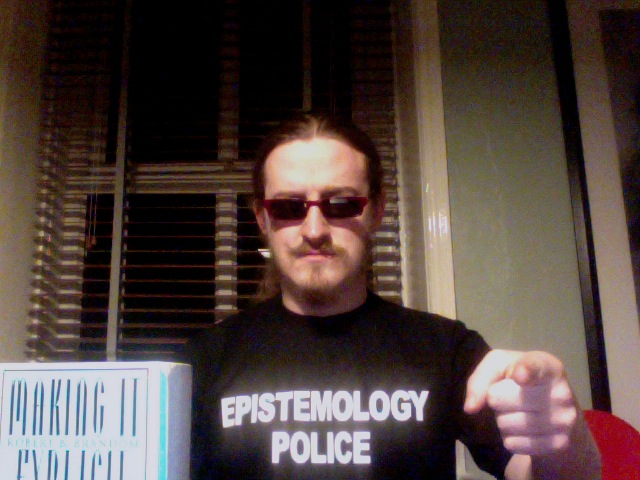
Back in Black

Hello again everyone. I’m back once more. It’s been a pretty turbulent year, but I have to apologise to my readers for dropping off the face of the earth for a few months. I owe deeper apologies to others who I’ve left hanging. If you know me and haven’t heard from me in a while, please do feel free to get in touch.

I have now submitted my thesis, albeit in a form I’m less than happy with. No doubt the viva will force me to revise some bits of it, and I will most likely revise even more of it when I’ve had a bit of break, but, for now, you can grab the full thing here.

The good thing about having finished (or at least submitted) is that I can now work on other projects without guilt. This means that I’m finally writing a couple of papers I’ve been intending to write for a long time. I’ve also just finished a joint paper (with my good friend Tim Franklin) for Jon Cogburn and Mark Silcox’s Dungeons and Dragons and Philosophy anthology with Open Court, trying to apply Kant’s aesthetics to the RPG experience. I don’t know whether this will ultimately mean more or less activity on the blog. I’m still trying to get the whole hang of paper writing, as it’s a different beast from blogging or thesis writing. We’ll see how it goes.

Catch you all next time I have a suitably coherent series of thoughts.

New Commentary Section

I’ve just added a new page to the blog in which I’m cataloguing my engagements with other bloggers. This is largely because I keep having to direct people to specific bits of my debates with the OOO crowd, which are not always easy to find. Now they’re all linked to in one place, and there’s a lot more there than I remembered.

Update: Turns out I messed up a bunch of the links. They all now point in the right direction.

Deontologistics on Tour: Conferences, Posts and Comments

I’m currently sitting in a cafe in Dundee, waiting for  the the 21st Century Idealism conference to kick off, and writing my paper (don’t worry, I’ve got a detailed plan!). It seems that I’m going to be quite busy over the next few months polishing off the thesis and going to conferences. After this, I’ll be going to the Metaphysics of Evolutionary Naturalism conference at the American University of Beirut, which Ray Brassier has organised, and it looks fantastic (I’m particularly looking forward to seeing Dan Dennett and Ruth Millikan). Following that, I’ll be in Prague for the Normativity of Meaning conference, where I’ll get my first chance to see Robert Brandom present in person (the prospect of which makes me giddy as a schoolgirl). I’m then thinking of visiting a friend in Slovakia before heading across to Munich for the Aspects of Reason Conference (where I get to see Brandom again!). If there’s anyone out there who fancies catching up with me on my prospective European tour, drop me a line. I can’t guarantee anything, but it’s always nice to bump into people who read the blog (and it’ll be even nicer to do so on the continent!).

On another note, there’s been a couple great posts of late from a number of directions. I’ve commented on some of these, in ways that elaborate my positions on a few matters (especially on the nature of philosophical practice and philosophical style), so they might be of additional interest to some. I’ve also coined a few turns of phrase which I’m quite pleased with, so don’t be surprised if they turn up here or in published work.

First, there’s Reid Kotlas’ second post in his latest series – Preface on Clarity – which picks out a little bit from Brandom that is wonderful and elaborates on it a bit in discussion with myself and the Philosopher Sans Oeuvre. I go into my opinions about the famous analytic/continental divide a bit more there, along with my opinions on the correct use of stylistic devices such as metaphor in philosophical writing.

Second, there’s Duncan Law’s recent post on Brandom – Embodied Norms – where we’ve been having a cracking good discussion about our different perspectives on Brandom’s work, the nature of language (conception) vs. communication (information transmission), and the possibility of transcendental philosophy. I’m increasingly convinced that the distinction between the ability to grasp conceptual content and the ability to receive information is a piece with the Kantian distinction between the faculties of understanding (and reason) and sensibility (and imagination), with the bracketed faculty in each case being the ability to process what is grasped/received. These pairs can then be viewed as indicating that there is no conception/sensation without the relevant kind of processing. These correspond roughly to the Hegelian insight that there is no understanding without reason (to view them separately is to be in the abstract standpoint of Verstand), and the Heideggerian insight that there is no perception without concerned practice (no Sicht without Umsicht). It’s also where we locate the boundary between causal systems that are configured correctly so as to count as rational agents (and thus susceptible to certain forms of normative assessment) and causal systems that can’t (those that merely process information).

Third, there’s Jonas Jervell Inregard’s recent posts on inner sense and time in Kant and others – Inner Sense Part I: On Asking Better Questions and What is Time? – I haven’t added anything much here (though I’ve certainly been thinking about the topic a lot), but it promises to be a really interesting series of posts.

That’s all for now. Back to my paper! Absolute Idea won’t explicate itself…

The Light at the End of the Tunnel

I’ve just added a new page to the blog called: Thesis. I’m now at the point where I almost have a complete draft (and I emphasise that it is a draft). All I am missing is the concluding chapter, which I’m currently writing, along with a bibliography and complete and consistent footnotes (bad practice, I know). Given that I’m so close, and so many people have kindly offered to take a look at the thesis for me, the easiest thing for me to do is put it up here and let whoever wants to take a look at it do so. Comments are welcomed.

The current title of the thesis is The Question of Being: Heidegger and Beyond. This pretty much encapsulates what it is about. If you’d like a more detailed idea, read the introduction, which is only a couple thousand words long (shorter than most of my blog posts!). Right, now I can get back to the conclusion, and maybe the paper on Hegel I’m giving at the 21st Century Idealism conference in Dundee!

Transcendental Realism

Greetings to all. It’s a bit late for an update, but, as others have already noted (here and here), the Transcendental Realism Workshop that happened last week went very well. I was most pleased with the way the various papers fitted together. A number of important issues recurred throughout the whole day: the relation between metaphysics and science, the nature and importance of rationality, the structure of concept revision, the interface between the natural and the normative, the role of the social in the structure of knowledge, and the significance of Kant’s philosophy.

As Dave Allen has pointed out, one of the most heartening things about the day was the that the great divide between Continental and Analytic philosophy was notable only by its absence. There was no attempt to bring one to the other, but simply a willingness to work as if the boundaries were not there.

I won’t comment too much on individual papers, as I’ll let those of you who’re interesting hear (or read) them for yourselves. We have the audio for the first three papers (Tom‘s, Reid‘s, and mine), but not for any of the others. Reid and Tom should provide revised electronic copies of their papers at some point (I believe). James Trafford didn’t want to make his paper available, as it is going to form part of his book for zerO on revisionary naturalism. It was an interesting paper, so we’ve got lots to look forward to there. Nick’s paper is available below in electronic form.

Tom O’Shea – On the Very Idea of CorrelationismTom O’Shea Q&A

Reid Kotlas – Transcendental Realism, Historical Materialism, and the Problem of Freedom / Reid Kotlas Q&A

Pete Wolfendale – Objectivity, Reality, and the In-Itself: From Deflationary to Transcendental RealismPete Wolfendale Q&A / Handout

Nick Srnicek – Traversing the Gap: Actor-Network Theory and the Forward March of Science

Unfortunately, we forgot to set up the mike for Ray’s talk, which is a testimony to how extremely tight the schedule was, and how stimulating the inter-talk discussion was. Doubly unfortunately, his presentation was given from notes, and so I can’t even give you all an electronic copy. To give you a brief low-down, he gave a fascinating introduction to Sellars as the best kept secret of 20th Century philosophy. He presented him as something of the Captain Beefheart of philosophy – nobody reads him, but his influence is everywhere. He also presented him as trying to make good on the promise of Kant’s philosophy.

The importance of Kant’s work was something which hung over the whole workshop, and when I came to revise my paper to put it online it stuck with me. I was unhappy with the final argument of my paper, and so my initial intent was only to extend that particular section. However, this turned into over a weeks worth of work (which is part of the reason for the delay), extending the paper into something more like a small treatise on transcendental realism, and the possibility of radicalising Kant’s philosophy. Given that Graham has just posted about the datedness of Kant’s work (here), I think it fitting to post this extended essay as a systematic rebuttal of sorts.

The essay contains the original paper (although somewhat extended), but also contains a large section working out the consequences of the argument for transcendental realism it provides. This recapitulates a lot of thoughts I’ve laid out on the blog over the last year, but in a more systematic and polished form. It’s far from a finished piece. It points in the direction of a larger project, but it provides a very good overview of this project, which reveals what I believe to be its philosophical depth and systematic scope. For anyone who finds the argument of the audio version wanting (as you should) and anyone who wants to know where I intend to take it (as I’d like to think you should) I strongly recommend giving this a read. It also contains a stripped down but fairly incisive critique of both Meillassoux and Graham, which I think many of you will find enlightening. However, it is rather long (24,000 words or so), thought it should be quite easy to read in parts.

Anyway, here it is: Essay on Transcendental Realism

Transcendental Realism Workshop (with Ray Brassier)

Finally, here is the official announcement for the Transcendental Realism workshop that’ll be taking place here at Warwick next month. I’ve left this tragically late, but hopefully not too late to discourage most people from coming. Once again, this event will have a number of familiar names from the blogosphere, including Nick Srnicek (Speculative Heresy / The Accursed Share), Reid Kotlas (Planomenology), and Tom O’Shea (Grundlegung), along with myself and James Trafford. We will also have Ray Brassier giving the headline talk, discussing his current interests in Sellars and Kant. All in all, this should be a really interesting event, so I recommend anyone who is interested to come on down to Warwick and join us.

Warwick Transcendental Realism Workshop

Time: Tuesday 11th of May, 12:00pm (registration) – 7:00pm

Location: University of Warwick, LIB2 and S0.11

Organised by Pli: The Warwick Journal of Philosophy, in conjunction with the Research Group in Post-Kantian European Philosophy

The purpose of the workshop is to examine the arguments underlying the increasing push towards realism in parts of modern continental philosophy, along with approaches that bridge the analytic/continental divide, and to assess the possibility of transcendental approaches to realism within this context. Particular themes that we be focused upon include:-

– The arguments of Quentin Meillassoux, and the possibility of transcendental responses to the problems he raises.

– The relation between epistemology and ontology.

– The relation between philosophy and the natural sciences.

The event will be split into two parts. The first part will take place in LIB2 (in the university library building) from 12:30pm to 5:00pm, which will consist in five papers presented by graduate students on matters relevant to the topic, along with discussion. The second part will be the headline talk, given by Ray Brassier, which will take place in S0.11 (in the social studies building) from 5:30pm to 7:30pm, under the auspices of the department’s regular Colloquium in European Philosophy.

Speakers

Ray Brassier (Philosophy, American University of Beirut) – ‘Kant and Sellars: Nominalism, Realism, Naturalism’

James Trafford (Philosophy, Unaffiliated) – ‘Follow the Evidence: Realism, Epistemology, Semantics’

Reid Kotlas (Philosophy Grad Student, Dundee) – ‘From Transcendental to Abstract Realism: Epistemology after Marx’

Nick Srnicek (International Relations PhD Student, LSE) – ‘Extending Cognition: Bridging the Gap between Actor-Network Theory and Scientific Realism’

Tom O’Shea (Philosophy PhD Student, Sheffield) – ‘On the Very Idea of Correlationism’

Pete Wolfendale (Philosophy PhD Student, Warwick) – ‘Objectivity, Reality, and the In-Itself: From Deflationary to Transcendental Realism’

The workshop is free to attend, but please email pete.wolfendale ‘at’ gmail.com to register in advance, or to request any further information.

Laruelle (non-)Event

This is being advertised a bit later than intended, but the philosophy society at Warwick (a top notch student run organisation) has organised a visit by Francois Laruelle, who will be presenting a paper (in French, accompanied by a written English translation courtesy of Anthony Paul Smith of An Und Fur Sich) on his more recent thinking. This will take place on the 3rd of March (less than a month away!), on Warwick Campus (further details in the announcement below).

For all of you budding non-philosophers out there, I here that the paper reworks a number of the core ideas of his earlier work. And for everyone familiar with our little section of the blogosphere, Laruelle’s talk will be preceded by a series of presentation on non-philosophy by none other than Nick Srnicek (Speculative Heresy / Accursed Share), Anthony Paul Smith, and Reid Kotlas (Planomenology). It promises to be lots of fun all round.

There is also another event that we’re organising at Warwick, a small workshop on Transcendental Realism, headlined by Ray Brassier. I will post more about this when all the details have been worked out. Anyway, here is the announcement about the Laruelle event that just went out on Philos-L, which provides more of the logistical details.

Continue reading Laruelle (non-)Event