‘Only the Death of God Can Save Us’

My talk for the Newcastle Philosophy Society on Saturday (discussed in the last post) went very well . Although I didn’t get to prepare as much as I might have liked, the ideas came together in a way that people seemed to understand, and it provoked a lot of interesting discussion. Despite the controversial thesis of the talk, there was no hostility or incredulity in the face of the claims I was making. What a wonderful way to spend a Saturday afternoon: eating pizza, drinking coffee, and talking about the death of God with a bunch of non-philosophers who are just interested in the topic.

Anyway, I managed to record a video of the talk on my laptop (giving it a slightly weird angle), and I’ve uploaded it to youtube (see here). The talk takes up the first 30 minutes. This is followed by a 30 minute Q&A session with a respondent, and a further 50 minutes of less focused discussion.

As another point of interest. Ray Brassier’s most recent talk ‘How to Train an Animal that Makes Inferences: Sellars on Rules and Regularities’, is now available online courtesy of Lorenzo Chiesa (see here). It’s Ray at his best: clear exegesis of Sellars with wonderful and incisive commentary upon the consequences that must be drawn from it. It also contains a small exchange between Ray and Zizek, which fans of both/either may find interesting/entertaining.

Finally, I’ve just finished making the final edits to the submission draft of my thesis. It contains no substantial changes from the current available draft, other than the fixing of a few typos and the inclusion of an acknowledgements page. However, I feel bound to put it up here for the sake of completeness if nothing else. It’s available on the usual page, linked in the sidebar. Now I’m free to finish a paper I’ve been working on for a couple months now. I’m sure you’ll all be interested to read it once it arrives!

Doctorates, Divisons, and the Death of God

It’s finally happened. I’m now (or at least am soon to officially be) a doctor of philosophy. My viva took place on Friday the 13th of January (an ominous date, but then, I was born on the 13th, so I suppose it’s my lucky number). It all went much better than expected. My examiners were Peter Poellner (internal) and Stephen Mulhall (external), and they were both very pleasant and helpful in the points they made about the thesis. They also passed it without corrections, which is incredibly nice of them. So, as of right now, I’m on the job market (offers anyone?). My biggest problem is that I currently have no publications (despite the several hundred thousand words posted on this blog). So, my goal this year is to turn all of the various bits of philosophical material I’ve written over the past few years into as many publications as I can manage, plus a few more original ones for good measure. I’ll let you all know more about them as they appear.

In other news, it appears that at the same time I was having my viva, I was being discussed in some small capacity in a paper given by Louis Morelle at the ENS (see here). I’m completely delighted by this, and I’d love to hear from anyone who was there (or from Louis himself, if he’s out there!) This was in the context of giving an overview of the philosophical divisions that have emerged in (or perhaps out of) Speculative Realism. On Morelle’s account, I stand allied to Ray Brassier’s naturalistic strand of SR, along with Martin Hagglund (who I’m afraid I haven’t read very much, which I must rectify). This is correct, as far as it goes. I’ve just recently laid out in brief the relationship between my work and Ray’s (here) and although there’s more to be said about it, it’s clear that he’s my closest philosophical ally. However, I didn’t say anything about my relation to SR there, and so I feel it appropriate to say something about it in light of this development.

Continue reading Doctorates, Divisons, and the Death of God

No Givenness Please, We’re Sellarsians

Dan Sacilotto over at Being’s Poem has just put up an excellent post discussing some issues that myself and Ray Brassier have been working on, in the light of a comparison between the two titans of Hegelianism in contemporary philosophical world: Badiou (the paragon of mathematical ontology) and Brandom (the paragon of inferentialist semantics). As Dan was so generous in the complements with which he opened his post, I feel I should say a little something in return. The pleasure in our correspondence has been entirely mutual. Dan is an incredibly enthusiastic and sincere interlocutor, and he’s consistently challenged me to improve both the content of my ideas and their form of expression. He’s also patiently and valiantly attempted to explain Badiou to me, and has been very helpful, in spite of my persistent inability to grasp what Badiou means by ‘presentation’. Dan exemplifies a lot of the virtues of a good philosopher: he’s intensely autodidactic, philosophically omnivorous, he doesn’t pull his discursive punches, and he refuses to write about things unless he thinks he understands them. All in all, a top chap.

Now that that’s out of the way, I’d like to address a few of the aspects of Dan’s post. I’m not going to cover everything, as it’s filled to the brim with interesting content. However, I do think that I can present my own point of view on several issues in a bit more detail, and provide some additional context for those who aren’t aware of the way mine and Ray’s Sellarsian projects have been developing of late. To this end, I’m going to carry on my recent practice of quoting from my own correspondence, and post a few snippets from my correspondence with Ray.

However, before I get down to this it’s useful to quickly summarise the central point of Dan’s post. His basic idea is that, although their rejection of the primacy of phenomenal givenness is highly laudable, both Badiou and Brandom end up going too far in minimising the role of experience, especially in their rejection of the role that sensation plays within it. Although the way this happens within each philosophical system differs, he takes it that they both seem to collapse back into something like Hegelian idealism, albeit from opposite directions. He sees myself and Ray as attempting to avoid this danger by championing the work of Sellars, ameliorating the Hegelian dangers of Brandom and Badiou by returning to a more Kantian approach to the relation between thought and Being. The aim here is to give experience its due, without collapsing back into the Myth of the Given, and thereby establish both the principled separation and effective connection between mind and world. However, Dan also suggests that Ray’s greater interest in Sellars’ account of sensation (and the associated notion of picturing) keeps him safer than my own more Brandomian proclivities. Needless to say, I’ve got a few points I’d like to make about this.

Continue reading No Givenness Please, We’re Sellarsians

More from the Archives: MA Essays

Hello again. I’ve had a few requests for some of my old essays from several people, particularly an essay I wrote on Foucault and Kant for my MA which provides the context for a lot of what I’ve been writing about Foucault of late. I figure it’s easier just putting these up on here, rather than having to keep emailing them to people, so I’ve added them all to the Other Work section.

It should go without saying that my views on a whole host of topics have changed a lot over the past few years. I was much more Deleuzian and a lot less Kantian when I wrote all these, and it shows in places. They’re also pretty dense and convoluted in places, particularly the essay on Hegel’s Logic and the dissertation on Deleuze. If you read them, take everything they say with a pinch of salt.

Anyway, time to get back to preparing for my viva!

For the Love of Spinoza

Happy New Year everyone. Levi recently put up an interesting post about Spinoza’s account of the relation between causal knowledge and ethics (here). As some of you may know, I’m quite a big fan of Spinoza. Not just of his metaphysics, but also of his resistance to Aristotelian teleology and his resolve to think freedom in a way compatible with his completely deterministic metaphysics. As I’ve argued elsewhere (here), Spinoza reconciles freedom with the principle of sufficient reason in a much healthier manner than Leibniz, and a lot of contemporary debates on this issue can be interpreted as taking place between neo-Leibnizians and neo-Spinozists. I’m firmly in the neo-Spinozist camp, but this doesn’t mean that I agree with Spinoza completely. Levi’s post very clearly outlines one of the points where I have an important disagreement with him (and his heirs), so it’s useful to address it. It also gives me a good excuse to work through some of the ideas I’ve been having about ethics and politics over the past few months.

This post is another fairly long one (8,000 words or so), but it not only contains my thoughts on Spinoza, but also some thoughts on Kant, Foucault, Sellars, Hegel, and Plato, which it pulls together to provide the outline of a theory of Justice. That may sound a bit over the top, but I’m nothing if not ambitious. Anyway, on with the show…

Continue reading For the Love of Spinoza

One from the Archives: Negativity

Although I’m working on other things at the moment (though very slowly, due to this rotten cold), it occurred to me that I’ve got a bunch of material lying around in my email account from various conversations I’ve had with terribly interesting individuals. Some of this is fairly easy just to copy and paste onto the blog, so there’s no good reason not to do so. I’m going to post them pretty much as is, and any necessary corrections or revisions will appear in ‘[…]’.

To start with, here’s something I wrote in response to a really excellent question from Alex Williams on my understanding of the relation between politics and negativity. It doesn’t really talk about politics much, but rather tries to disambiguate various ways in which the concept of negativity can be deployed philosophically. Hope you enjoy.

——
I haven’t read Benjamin Noys book on the matter, which I suspect I should, but I’m generally very skeptical of the way ‘negativity’ and ‘positivity’ get used in much of mainstream continental philosophical discourse. It’s one of my pet peeves actually, because it often ends up running together logical and metaphysical issues with metaphorics of affectivity (‘we must be positive’ or ‘we must be negative’, etc.). That said, I’ll try and disentangle the bits I think something can be said about as best as I can.

There’s basically three different registers in which talk of negativity is relevant: philosophy of logic, philosophy of subjectivity, and metaphysics. These overlap insofar as subjects can be conceived as necessarily having the capacity for reasoning (which is made explicit using logical vocabulary) and insofar as there are questions about the subjects place within reality (and the relation between logical and metaphysical structure more broadly). To understand the relations between these different ways of talking about negativity I’d like to trace a few historical debates running through Spinoza, Hegel, Deleuze, Heidegger, Sartre and Brandom.

Continue reading One from the Archives: Negativity

Back in Black

Hello again everyone. I’m back once more. It’s been a pretty turbulent year, but I have to apologise to my readers for dropping off the face of the earth for a few months. I owe deeper apologies to others who I’ve left hanging. If you know me and haven’t heard from me in a while, please do feel free to get in touch.

I have now submitted my thesis, albeit in a form I’m less than happy with. No doubt the viva will force me to revise some bits of it, and I will most likely revise even more of it when I’ve had a bit of break, but, for now, you can grab the full thing here.

The good thing about having finished (or at least submitted) is that I can now work on other projects without guilt. This means that I’m finally writing a couple of papers I’ve been intending to write for a long time. I’ve also just finished a joint paper (with my good friend Tim Franklin) for Jon Cogburn and Mark Silcox’s Dungeons and Dragons and Philosophy anthology with Open Court, trying to apply Kant’s aesthetics to the RPG experience. I don’t know whether this will ultimately mean more or less activity on the blog. I’m still trying to get the whole hang of paper writing, as it’s a different beast from blogging or thesis writing. We’ll see how it goes.

Catch you all next time I have a suitably coherent series of thoughts.

New Commentary Section

I’ve just added a new page to the blog in which I’m cataloguing my engagements with other bloggers. This is largely because I keep having to direct people to specific bits of my debates with the OOO crowd, which are not always easy to find. Now they’re all linked to in one place, and there’s a lot more there than I remembered.

Update: Turns out I messed up a bunch of the links. They all now point in the right direction.

What are Concepts?

Well, it looks like it’s that time again. Following a prolonged exchange we had over twitter (itself precipitated by this post), Levi put up a few posts which, although they don’t mention me directly, are pretty clearly pointed this way (herehereherehere, and perhaps here). Given this, I feel it beholden upon me to respond to them, both to dissect some of the more problematic claims made therein, and to correct what seems to me are some serious misunderstandings of Brandom’s work. As regular readers of this blog will know, I am not famous for concision. This has lead to accusations that I practice ‘proof by verbosity’ or simply that I am ‘boring’. As I’ve said elsewhere recently (in the comments here), I don’t expect others to use their blogs in the way I use mine, or to keep up with reading the amount of material I publish. Nonetheless, I think it’s my right to criticise others in a manner of my own choosing, and to respond to criticisms of myself in kind. I’ll try to be as brief as possible, but there is a lot to respond to here, so I’m going to have to be selective.

It has equally been suggested (in the posts I am addressing no less) that the kinds of questions I focus on are too ‘academic’ (or perhaps not ‘feral’ enough), given my penchant for focusing on ‘What is…?’ questions. There is more to be said about this in relation to the matter at hand, but I think it’s worth pointing out that this form of questioning has an eminent philosophical (or perhaps ‘philosophical’) lineage, stretching back to literally pre-academic times. It is the preferred question form of Socrates, that most feral of philosophers, and most engaged with the needs of his time. Following his inspiration, I’ve decided to frame my response by confronting the difficult question underlying the debate: What are Concepts?

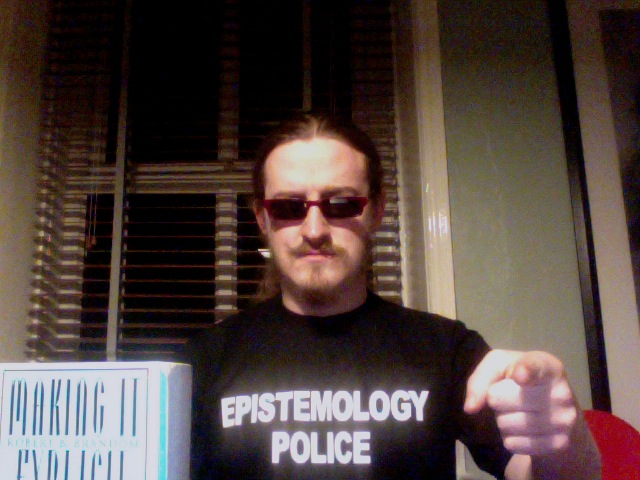
Do I adopt this mode of expression because I have a noxious and priestly will to power? Because I wish to stand in judgment over the fates of others? Because I wish to police, dominate, and render others subservient to my philosophical vision (one which is fascistically terrifying)? Or simply because I am a pervert? Perhaps. Does it make a difference? Probably not. Let’s see.

Continue reading What are Concepts?