Transmodern Philosophy

For those of you who don’t yet know, I have spent the last few months organising a Summer school at the Haus der Kulturen der Welt in Berlin with Armen Avanessian and Reza Negarestani. The revised program for the Summer school with links to the recommended readings is now available (here). I can now also reveal that there will be a blog (Transmodern Philosophy) on the 60pages curation platform that is beginning today (Navigating the Philosophical Landscape), and which will provide some opening thoughts along with ongoing commentary on the various seminars over the course of the school.

UPDATE: I accidentally updated a draft version of the new programme rather than the finished one. The link has now been changed.

Berlin Summer School (Abstracts)

For anyone who hasn’t come across it yet, I have recently been involved in organising a Summer school in Berlin this July (1st to 12th): ‘Emancipation as Navigation: From the Space of Reasons to the Space of Freedoms’ (see here). I’m also due to discuss some of the themes of the school with Anthony Paul Smith this coming Thursday (see here). I’m afraid that applications for places at the Summer school have already closed, but there should be some outputs from it that I will be sure to flag up here as they appear. In the meantime, here are the abstracts for the two sessions I will be leading:

Freedom and Reason

This first session aims to outline the connection between the concepts of freedom and reason. We will begin by tracing the dialectic of the concept of freedom, beginning with Spinoza and Leibniz’s attempts to make free will compatible with the principle of sufficient reason, and showing how this debate is refracted through Kant’s account of rational agency. We will see how this refraction splits the Kantian tradition into an authentic Spinozan form (Hegel, Marx, Foucault, and Sellars) and a vulgar Leibnizian form (Schelling, Sartre, Badiou, and Žižek). We will then outline Sellars’ authentic reconstruction of Kant’s account of individual agency, and use this to delineate two strands of post-Kantian thought about collective agency (Hegel-Marx and Heidegger-Foucault), before integrating them with Brandom’s Hegelian extension of Sellars’ Kantianism.

Navigation and Representation

The second session aims to approach the connection between freedom and reason from the opposite direction, by providing an account of the specifically linguistic capacities that a rational agent must possess to count as a rational agent. We will begin by tracing the dialectic of the concept of language in the 20th century, focusing on the analytic tradition that grows out of the philosophy of logic at the end of the 19th century. We will do this by framing the development of this tradition in terms of Brandom’s logical expressivism – the idea that logic is the organon of semantic self-consciousness, or that the role of logical vocabulary is to make explicit what is otherwise implicit in what we do. This will allow us to see the various blockages in the tradition’s development as forms of semantic false-consciousness engendered by fixation upon a particular logical vocabulary at the expense of the more complex pragmatics of which it expresses a fragment. We will then attempt to show how Brandom’s inferentialism aims to explain representation in terms of the pragmatics of dialogical reasoning, and how this identifies the capacity for dialectical navigation as the crucial connection between freedom and reason.

Incredible Machines Talk: Technocracy and Class

It’s been a while since I’ve managed to put anything up here. However, I recently gave a short presentation at the Incredible Machines conference in Vancouver – via google hangouts – on the intersection of the ideas of technocracy and classless society. The conference was very interesting, and a really impressive experiment in teleconferencing, though it was hit by a few technical problems. The audio cut out during my presentation, but I was very graciously given the chance to re-record it. The result was somewhat longer, but also somewhat clearer than the original. It is now available online here. Enjoy!

Dialectical Insurgency

As anyone who has been reading this blog for any length of time knows, brevity is not one of my virtues. I’m quite pleased with the whole project of Deontologistics, and still plan to continue posting the sorts of long pieces that it’s known for (albeit less frequently than I used to). However, I’ve come to realise the benefit of having a space to express thoughts that are too long for twitter (@deontologistics) but too short or ill-formed for me to be comfortable posting them here. At the same time, although I have occasionally touched on topics that extend beyond pure philosophy, this blog is very much a philosophy blog, and I’m reluctant to use it to take positions on questions of politics, art, and other issues.

For these reasons, I’ve opened up a new tumblr blog, Dialectical Insurgency, with the aim of encouraging myself to share (and thus formulate) shorter and more in-progress ideas on a variety of topics.  I’ve just put up some thoughts on cognitive economics and stress that’ve been floating around in my brain for a while now. I hope some of you might find it interesting.

Burning Bridges

I’ve read a couple interesting posts over the last few days on the topic of the analytic/continental divide. The first was Jon Cogburn’s post linking to Ray Brassier’s talk on Sellars’ Nominalism at the Matter of Contradiction conference in London in March (the video unfortunately cuts out before the Q&A that I was involved in). Jon presents some interesting remarks on the ‘divide’ from the perspective of someone with analytic training who has subsequently attempted to enter the world of continental philosophy, at least in its American form (the centre of which seems to be SPEP). The second was Roman Altshuler’s post on the importance of dialog between continental and analytic philosophy. Roman’s post is a fantastic contrast to Jon’s insofar as it seems to come from the opposite direction: someone with loosely continental training coming to analytic work later, albeit from a European perspective (in which the ‘divide’ is configured quite differently). In addition, the comments on Roman’s post raise some very interesting issues, such as the problems caused by differences in the way AOS/AOC distinctions are configured between the traditions (i.e., thematics vs. history) . This is something that causes me serious headaches when trying to put my own CV together. I usually find discussions of the divide to be severely worn and uninteresting, but these were exceptions and are very worth reading.

Still, I think I should probably briefly state my own view of the issue here, as it has mutated quite a bit over the years. In short, I think the ‘bridging’ metaphor in terms of which these debates are usually configured has become part of the problem labelled by the word ‘divide’ and that it must be burned if we are to solve this problem (or any subset of problems that constitute it). I studied both analytic and continental philosophy at undergraduate, did an MA in Continental Philosophy with a dissertation on Deleuze’s metaphysics, did a PhD on Heidegger’s account of the Question of Being and its relation to metaphysics, and am now heavily bound up in work on Quine, Sellars, Brandom, and a number of self-identifying analytic thinkers. I have discovered time and time again that I simply do not fit in to the neat set of categories that the divide/bridge framing sets up. Continue reading Burning Bridges

Freedom, Beauty, and Justice (via the Accelerationism Workshop)

As many of you will already know, there was a small workshop on the theme of accelerationism at Goldsmith’s earlier this month, at which myself and a few others spoke. Despite two out of five speakers having to pull out on short notice due to illness, the workshop went very well, and I was rather pleased with the talks and the discussion that ensued after them. However, given the absence of those speakers, we didn’t really come close to defining ‘accelerationism’, which is still a nebulous term, even if it connects many things that we were all interested in. For this and other reasons, not everyone was happy having the talks and discussion recorded and put online.

However, I’m quite happy to make my own talk available, as it does a good job of connecting various things I’ve discussed on this blog over the last couple years, most importantly my concerns with the concepts of Freedom, Beauty, and Justice, and the connections between them. The talk also contains some quick remarks on the critique of liberalism, but I didn’t have the time to develop these in the depth I’d like. Hopefully I’ll get the chance to work all this up into a more coherent and detailed piece at some point. For now, you’ll just have to listen to this.

More Atheology on Deleuze

Atheology has just put up another post on my interpretation of Deleuze, this time based on my more recent paper ‘Ariadne’s Thread: Temporality, Modality, and Individuation in Deleuze’s Metaphysics’ (available here). It’s a very generous and thorough reading of the paper, in relation to the other things I’ve written about Deleuze on the blog. Though he expresses a certain dissatisfaction with the unfinished character of the essay (it was written for an hour length presentation, and alas, was inevitably consumed by preliminaries) in parallel with his dissatisfaction at the unfinished character of my posts on Deleuze and Sufficient Reason (available here), he also says:

This strikes me as an extremely promising angle of approach and one which could easily yield a book-length treatment, perhaps under the title Ariadne’s Thread: Deleuze and the Song of Sufficient Reason. For me this approach represents tangible progress in the study of Deleuze’s thought.

I can only feel humbled by such praise, and would love to write this book one of these days. Alas, I am stuck in the same position as many of my compatriots, unsure as to which aspects of my work will lead to stable employment, so it’ll have to wait for now. That being said, I do intend to extend the ‘Ariadne’s Thread’ paper for publication at some point, once a few other commitments are out of the way. As such, the comments in Atheology’s post are very helpful and useful. However, there are a number of possible misunderstandings and points that can be addressed quickly, and so I will endeavour to do so here. I’ll try to number the points to keep them brief and organised. Continue reading More Atheology on Deleuze

The Art Kettle

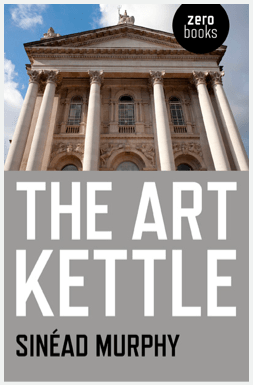
This post is in many ways long overdue. I received a free copy of Sinead Murphy’s The Art Kettle last year, with the promise that I’d review it. The book made an instant impression on me, but for various reasons (personal and professional) the review went by the wayside. I returned to the book recently with the intention of finally finishing the review and submitting it to the British Postgraduate Journal of Aesthetics. However, I found it even richer than the first time I read it, and the piece quickly spiralled beyond the word limit of a short review (it was meant to be 2000 words, and is now around 6000). Re-reading the book and writing the review has helped me to focus and develop some of the ideas about aesthetics and beauty that I’ve been discussing for a while now, and which I discussed with a number of people at the recent Speculative Aesthetics event in London. It thus contains a brief, but reasonably thorough overview of my more mature thinking on these topics, and may be of interest to those who read this blog.

As such, I’m putting up the current draft for people to read: ‘The Ends of Beauty: Sinead Murphy’s The Art Kettle. This should get edited and adapted for publication soon (possibly in Pli, possibly elsewhere), and so comments are thoroughly welcomed. Finally, it should go without saying that I think you should all buy this book. If you’re interested in art-theory, and particularly if you’re fed up of the state of contemporary art, The Art Kettle will stimulate you and give you new theoretical tools to deal with it. Plus, it’s cheap, short, and well written. What’re you waiting for?

Atheology on Deleuze and Sufficient Reason

This is a very quick post to point people at a new blog called Atheology (now linked in the side bar), which has just put up a post (see here) commenting on my ‘Song of Sufficient Reason’ series of posts on Deleuze and the PSR (see the Important Posts section). That series of posts never got finished for various reasons, the third instalment being lost somewhere along the way. However, a lot of the unresolved threads are picked up in my more recent ‘Ariadne’s Thread’ paper on the overall shape of Deleuze’s metaphysics (see the Other Work section, or the Video section). It’s wonderful to find someone commenting so perspicuously on work I thought everyone had forgotten about (myself included). I look forward to reading more from Atheology on these and other topics as it appears.